Exclusive Deal

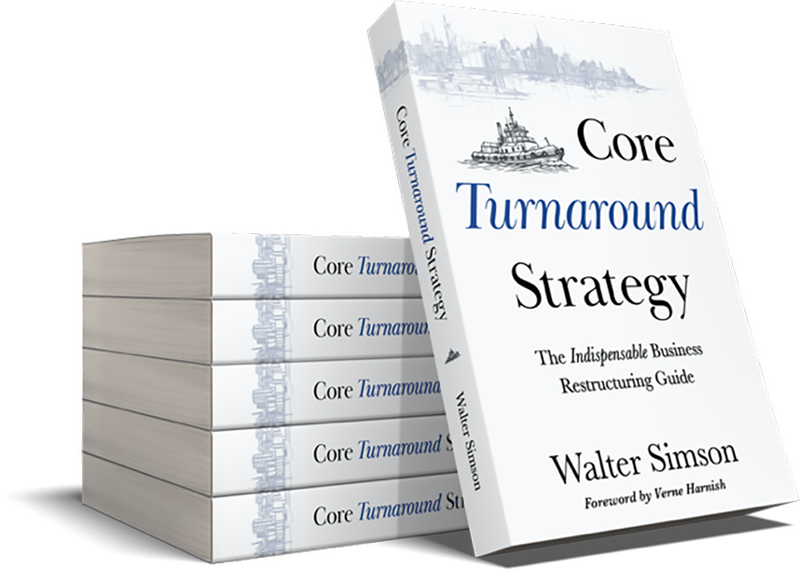
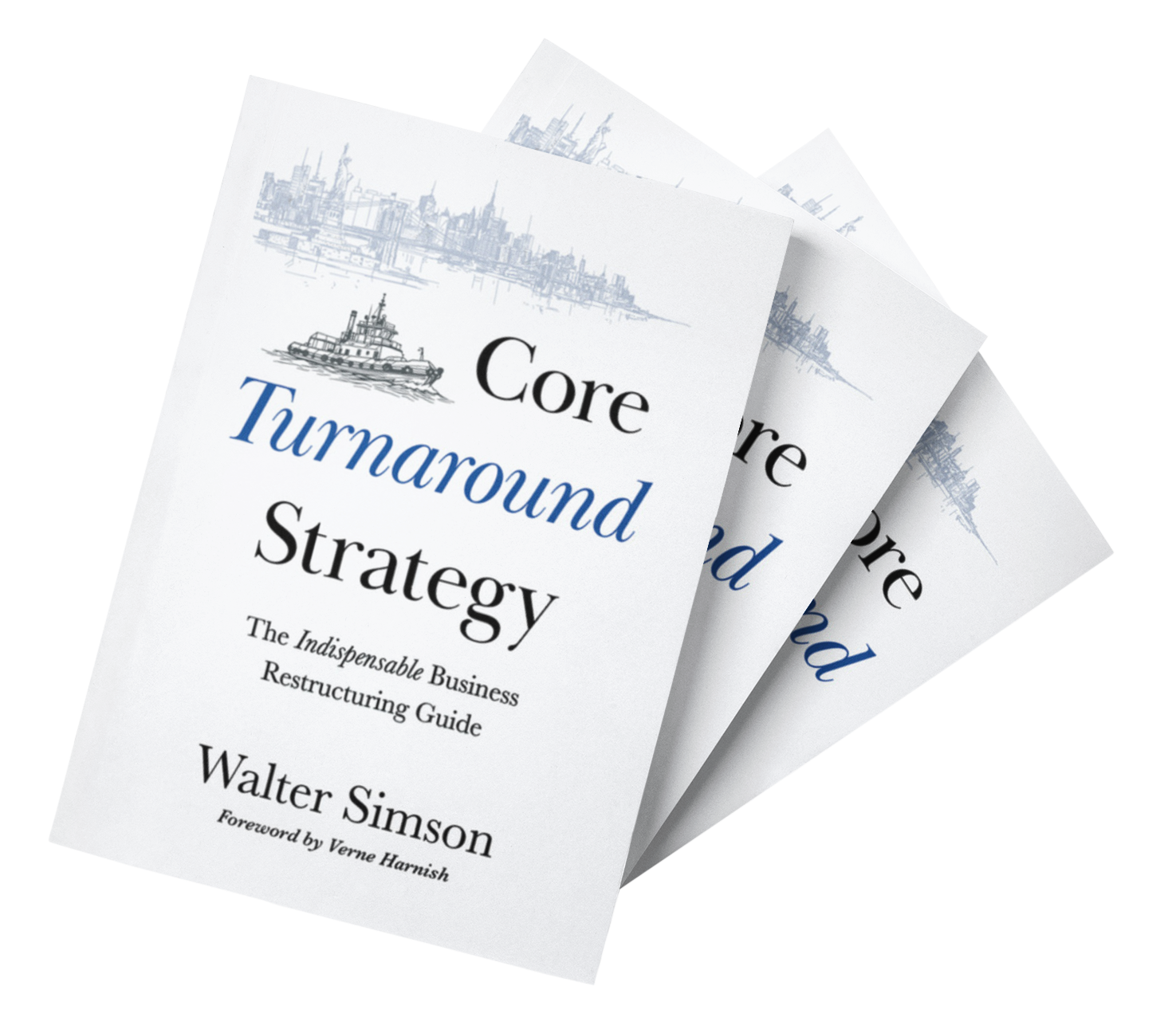
Core Turnaround Strategy

The Indispensable Business Restructuring Guide
Critical Strategy Tools You Need for Successful Business Recovery

This book offers a systematic approach to rebuilding a company’s foundations after they’ve crumbled.

Available now
Core Turnaround Strategy

The best turnaround leaders don't wait for perfect conditions. Neither should you.

Financial distress often signals strategic drift—when companies lose sight of their core products and core customers.
tugboat
core turnaround strategy

The Core Product/Core Customer Framework gives you the diagnostic tools to identify underlying issues, confidently create a plan, and immediately start implementing.

Business failure is pervasive. Twenty percent of companies fail in their first year. Sixty-five percent fail within ten years. These companies are unimportant to anybody but their communities, their employees, their bankers and their founders. In other words, to pretty much everybody to be found within a wide radius.

This book is designed to guide advisors and leaders who need to deal with business turnarounds. 

I bring them through a known route to profitability. It’s like opening a paper map: once you have found North and a few landmarks, the path forward will be easier. Even familiar.

I endorse a timeless standard: be indispensable. David Ogilvy, who founded New York’s most successful advertising agency, set the bar in Confessions of an Advertising Man. It became my mission—one I’ve pursued through four decades turning around distressed companies.

Traditionally, turnaround management required extensive prior experience—a Catch-22 that kept many capable advisors on the sidelines. Lack of familiarity automatically disqualified the new practitioner.

This book changes that.

When Companies Lose Their Core

Turnarounds, by definition, never happen at an opportune time. Companies in distress cannot afford to wait for perfect conditions—they need immediate, decisive intervention. My goal is to help you take massive action to improve the situation, no matter how dire the circumstances.

This book provides advisors and leaders with tools and stories to make all turnaround situations follow a known road to profitability.

The Core Problem

Most companies once had a strong core. They became turnarounds because something changed. I think that “something” is often a series of common, correctible errors. We don’t often discuss mistakes in business, and talking about “errors” sometimes jars leadership teams—as if errors are shameful.

But errors happen to businesses the way injuries happen to athletes. It’s simply the price of playing the game.

The symptoms show up everywhere:
The underlying cause? Companies gradually lose sight of their core products and core customers.

This isn’t dramatic failure. It’s a result of often-disconnected efforts to diversify, grow and become significant.

The challenge? The cumulative errors that are causing distress are hiding in plain sight—masked by measurement problems and buried in execution chaos.

You’re managing symptoms without seeing the underlying condition.

That’s where the diagnostic framework comes in.
tugboats

The Plan-Team-Financing Framework

Over 40 years and a few core turnarounds, I've found that lasting recovery isn't about cutting faster—it's about fixing smarter. Three elements must work together.

The Plan-Team-Financing Trilogy

Every successful turnaround requires three elements working in concert:

Plan

This is the most difficult part of any turnaround. After all, you’ve got little time, immense pressure, and a changing situation.

That’s where this systematic diagnosis makes the difference.

Start by identifying your true core products and core customers. How? By surveying the company for common, critical errors that hide core product/core customer performance:

Then you’ll learn about:

Team

Engage employees who help create the plan and own its execution. Systems to create alignment and accountability across every department, and banish blame from your leadership interactions.

Financing

Build credibility with lenders through consistent delivery on promises. Strategy, operations, and planning presented clearly—in documents lenders appreciate and teams can execute.

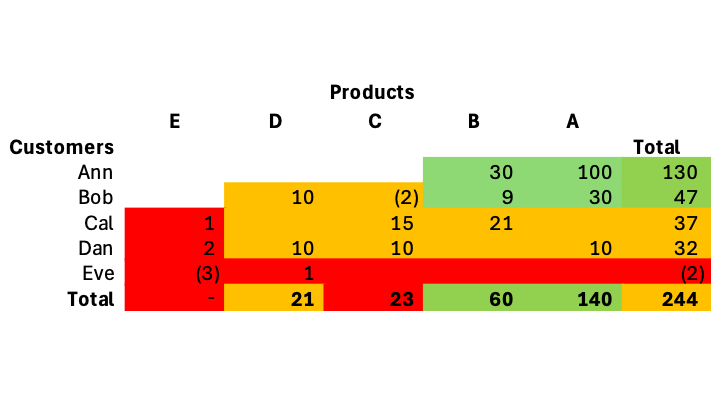
PLUS The Core Product/Core Customer X-Ray

A financial diagnostic that ranks all products and customers by actual profitability—showing exactly where you’re making money and where you’re bleeding cash. The X-Ray uses company P&L data to show the complete profit picture in a single view.

This isn’t theory.

It’s the methodology that saved a regional restaurant chain by closing unprofitable hours, rescued an ag equipment dealer by shifting from low-margin sales to high-margin service, and revived a promotional products company by fixing a single process error costing 12% of revenue. Strategy first. Cost-cutting second.

Brooklyn Bridge tugboat

Is This Book For You?

I wrote this book for advisors and leaders who work with companies in financial distress. While executives and board members will find great value here, I’ve found that advisors are often most attuned to this message. Why? Maybe because that’s the path I took. And also because they bring the analytical skills, objectivity, and availability that turnarounds demand.

Is it for you? You’ll find this book essential if you’re:

The frameworks work for any organization with the organizational capability to implement systematic change. And the book provides the tools and stories to make any turnaround situation follow a known road to profitability.

What You'll Learn

This book provides a diagnostic and implementation framework for turnarounds, described through six detailed turnaround stories.

Core Frameworks You'll Master:

The Plan–Team–Financing Trilogy – The three essential elements that must work together: how to diagnose errors, build teams, and secure financing through credibility.

Core Product/Core Customer Analysis – A systematic method to identify which products and customers drive profit—and which silently destroy business value.

The Three Error Types – How to diagnose Strategy Errors, Measurement Errors, and Execution Errors that hide a company’s true core business.

The Core Product/Core Customer X-Ray – Financial diagnostic that ranks all products and customers by actual profitability.

19 Practical Diagnostic Tools You’ll Use Immediately:

  • Error Review Guides (for Strategy, Measurement, and Execution)
  • The Daily Huddle
  • What is the company’s Unit of Measure?
  • Factory in the Front/Factory in the Back. A way to map company processes.
  • Frozen Managers/Company Financial Symptoms Checklist.
  • Cash Management for Receipts/Disbursements.
  • Cost of Quality.
  • Errors and Turnarounds.
  • Cost is Cost.
  • Project Management Template

…and others

Endorsements

From the Foreword:

“Walter Simson has spent four decades answering the toughest questions facing struggling companies. Core Turnaround Strategy offers powerful, actionable answers, showing how business challenges inevitably signal that important fundamentals are broken: Strategy has gone astray, or execution is failing. Team members may have lost confidence, or cash has gotten dangerously low.

This book offers a systematic approach to rebuilding a company’s foundations after they’ve crumbled. His focus on core products and customers will help leaders build the strategic clarity that must anchor any sustainable business. Many turnarounds look for cost-cutting when the real issue is strategic drift. Leaders who master the approach in Core Turnaround Strategy will become indispensable in their companies’ most critical moments.”

Verne Harnish
Verne Harnish

Founder, Scaling Up and Entrepreneurs' Organization (EO); Author of Scaling Up: Rockefeller Habits 2.0

"Walter Simson's focus on core products and core customers...is absolutely correct. He combines intellectual thought leadership with experienced practitioner insights."
Edward I. Altman
Edward I. Altman

Max L. Heine Professor Emeritus of Finance, NYU Stern School of Business

"Core Turnaround Strategy is a gem! It was written for consultants who rescue and resuscitate failing companies but works equally well as a handbook for CEOs."
Srikumar Rao
Srikumar Rao

TED speaker and Executive Coach

"Core Turnaround Strategy is a sharp, insightful guide to the art of corporate turnarounds. With vivid storytelling and practical frameworks, it shows how improvement—rooted in strategy, leadership, and financial clarity—can restore not just profitability, but purpose. Whether you're an advisor or a business leader, this book offers the tools to diagnose errors, build resilient teams, and take action when it matters most."
Christine Dahlhauser

Managing Principal at Baker Tilly

Inside the Book

Preface: Being Indispensable

How David Ogilvy’s standard to “be indispensable” became my mission through four decades of turnaround work.

Introduction: Finding North

Why traditional turnaround experience created a Catch-22 for new advisors, and how systematic methods change that. The plan-team-financing framework and three error types explained.

Chapter 1: Expense Cuts Don't Count

Story: Bentley Offset. I sorted job folders on a worktable and discovered that my father’s proudest product—specialty envelopes—was losing money, while simple letter printing was profitable.

Chapter 2: Strategy Fail, Cash Crash

Story: Whittenmaker Shoe. Daily cash management led me to a discovery: the “ugly” military dress shoe was highly profitable, while the beautiful fashion loafer made nothing.

Chapter 3: Cost is Cost, Measure is Measure

Story: Metal Bender. I found that crude machine cost allocations and political manipulation of numbers prevented managers from understanding their true performance.

Chapter 4: Core Product, Core Customer

The Core Product/Core Customer X-Ray methodology explained in detail: how to build it, interpret it, and use it to identify strategic drift. Includes heatmap visualization for pattern recognition. No story—pure methodology.

Chapter 5: Execution: Strategy Meets Reality

Story: Dutzen Finishing (Part 1). Process mapping and X-Ray analysis revealed execution problems: rework costing 9% of sales, image capture errors, and a “free work” culture undermining profitability.

Chapter 6: Microscope and Telescope – Scale Matters

Story: Dutzen Finishing (Part 2). I discovered small customer orders weren’t unprofitable—they just needed different delivery schedules. Organizational restructuring reduced the CEO’s direct reports from thirteen to six. Project management techniques.

Chapter 7: Great by Choice

Story: Dijon Family Restaurants. Multiple units of measure revealed that coffee—not breakfast platters—drove profit, and that coffee also had the worst execution problems. Evening hours lost money. Building cross-functional teams and formal meeting structures.

Chapter 8: Allocation and Leverage Blues

Story: Myna Tractor. I showed how “allocated” facility costs became political weapons. Real cost analysis revealed five of eight locations couldn’t cover occupancy costs. Service, not equipment sales, was the core business.

Chapter 9: Power in Purpose

The turnaround tools matrix showing which techniques apply to strategy, measurement, and execution errors. Finding meaning in turnaround work: “I work for handshakes.” My parting counsel: be indispensable.

Plus Appendices:

About the Author

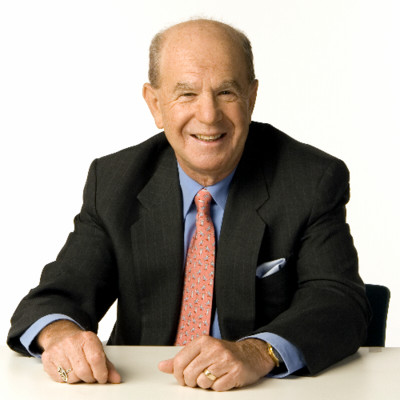
Walter Simson

I graduated from Columbia University and NYU’s Stern School of Business and started my career at Chase Manhattan. I’ve since spent 40 years turning around distressed companies, developing my systematic way to fix business distress.

I’ve learned that financial distress signals deeper issues—companies lose sight of their core products and core customers. Refocusing on that core leads to dramatically improved performance.

This insight led to Core Turnaround Strategy: The Indispensable Business Restructuring Guide. The book introduces the Core Product/Core Customer framework and shows how to use it to rebuild struggling organizations.

I live in Irvine, California with my lovely wife, Val.

Tugboats

Tugboats are critical to the functioning of every port. They greet ships from all around the world and help them find their proper berth. Tugs perform in all weather, all traffic and all seasons. Busy, unfussy and employed in only a small part of the larger enterprise, they are emblematic of those who help companies return to stability.

I began to admire tugboats when I lived overlooking Manhattan’s incredible harbor, and as I’ve travelled to working port cities like Hamburg, Busan, Houston, Yokohama, Baltimore and Antwerp, I’ve noticed the same basic inexhaustible utility and humble worth of these craft. I imagine tugboat captains all share a culture I admire so much.

tugboat drawing

Inspiration and Bibliography

David Ogilvy’s Confessions of an Advertising Man (1963) inspired this book. Ogilvy showed how to build and run an excellent advertising agency. Ogilvy combined personal stories and behind-the-scenes anecdotes with his systematic methodology, showing practitioners exactly how to build a successful practice. He set the standard: be indispensable.

Ogilvy provided clear principles for agency management. I provide the same for business turnarounds—systematic methods to diagnose distress and a proven framework to restore profitability.

Key Influences

Ogilvy, David. Confessions of an Advertising Man. Atheneum, 1963. The model for combining narrative with methodology.

Drucker, Peter F. Managing in Turbulent Times. Harper & Row, 1980. Pathbreaking advocate for building on existing strengths and abandoning what no longer works.

Deming, W. Edwards. Out of the Crisis. MIT Press, 1982. The foundation of the quality movement who advocated for continuous, systematic process improvement.

Harnish, Verne. Scaling Up: How a Few Companies Make It…and Why the Rest Don’t. Gazelles, 2014. The magical People-Strategy-Execution-Cash framework that has galvanized tens of thousands of companies.

Rao, Srikumar. Are You Ready to Succeed? Rider, 2007. Mental frameworks for sustaining effectiveness and satisfaction in high-pressure professional practice.

Excerpt: From the Preface

The pressroom shakes you up. Printing companies are huge, built to stage unprinted paper at the start of the process, run presses in the middle, and store finished products at the end. And then there’s the decibel level: printing presses are turbojets that manufacture words.

Why am I describing a printing plant? Well, one of them shook me up. This is where I started my career, by helping my family’s business. What started as a son’s obligation became a calling, one where I systematized my approach to save struggling companies.

I thought I might take a chance on this turnaround. I imagined that I’d find the expenses that were inevitably out of line, cobble together a budget and declare success. Then I could decide what I wanted to do with my life.

Frequently Asked Questions

Strategy is the issue? I thought it was cash flow?

Cash deficits and operational confusion are symptoms. I start earlier in the crisis timeline. You’ll learn to diagnose what’s really causing financial distress. The framework reveals when companies have abandoned their core products and core customers, giving you a roadmap to restore focus.

The framework scales. I developed it for middle-market companies ($25M–$500M in revenue) but it applies equally well to divisions of larger enterprises or fast-growing small businesses facing financial complexity.

I focus on performance improvement—strategy, measurement, and execution—not on short-term liquidity planning, working capital techniques, liability management, or balance sheet restructuring.

I compare this to “self-dentistry—theoretically possible, but painful.” Advisors can often bring specialized knowledge, skills and objectivity. That said, owners will find the diagnostic frameworks valuable for implementation with their leadership team.

Yes. Bulk and professional discounts are available for consulting firms, university courses, and client workshops. Contact info@coreturnaround to learn more.

Readers get access to free downloadable templates and diagnostic worksheets on our website. Choose from The Turnaround Diagnostic Checklist, The Indispensable Reading List, or the an excerpt of two essential tips from the book.

Yes. The audiobook will be available in March 2025.

Book specifications and pricing

Paperback: 192 pages, contains 36 figures.
Size: 5.5 x 8.5 x 0.5
Gloss cover
Pricing: $22.99/$19.99 prepub
Kindle: $9.99
Audio: $9.99

Core Turnaround Strategy

Recent posts

The World Sitch Is Only “Weird.” Get Ready for “Dangerous.”

People keep calling the current commercial environment “weird.” Tariffs announced and reversed in the same week. AI replacing junior analysts faster than colleges can graduate them.

“Weird” is manageable. “Weird” is cocktail party conversation. But weird is not the problem.

“Dangerous” is the problem. And dangerous is coming.

Read More »

Turnarounds From a Unique Perspective

Turnarounds require that you see the whole picture.

Luckily, I started in New York, a city that forces perspective. Stand on the Brooklyn Promenade and the whole city unfurls before you. Every block , every building, every business stacked together.

Read More »
Core Product/Core Customer X-Ray example

A Better Core Product/Customer Strategy Kicks Off

Last post, I shared how I found an expense-based turnaround to be wholly ineffective. Faced with that frustration, I dreamed that I could find a product or a customer whose profit would point the way to future prosperity. It would mean abandoning “expenses” and thinking “strategy.”

Read More »